Monday, July 25, 2005

AFL-CIO ; The debate on the future of Labour Unions

Since the advancment of capitalism in the western world, a parallel power structure where worker and his or her rights can be heard emerged. Since the early days of industrialisation, the empowerment of workers was seen as a primary factor for the better meant of human society. The furstrations of Maxistism can be felt in the low-lit, industries of cloth, steel, coal etc. It is the difference in how modern society would best benefit the working populations of lower classes. Socialism and Communisim project an worker-owned company, with shakeholder rights the most important factor in the management of the company.

Capitalism, in the era of industries and later, depended on managerial capacities to direct the company to best suit the human populations. However, due to increasing layers of management, the modern companies are run by shareholders themselves. It is the wall streets of the nations that decitate the future of capitalism. And wall street never like Unions. For them, having a stake in the company meant low costs and high revenues. High profits could them to be distributed to all the members of the shareholder community. Thus, the idea of Bush of creating an investor generation. As the dream of the next american socity, each house has investments in the market, thus directly benefiting from higher profits.

And by the way, higher profits can be achived where costs are low. Outsourcing makes low costs with increased quality and efficiency possible. Unions are losing their primary motive to operate. The populations they are committed to serve no lower need them. Outsourcing and high business blend of mind are not the only reasons for the loss of union people.

In a book i am reading called, "Our Modern Times: The New Nature of Capitalism in the Information Age" by Daniel Cohen, the author distinguishes three kinds of human capital: "General" "specific" and "Biographical".

"General" human capital is that which bears on the mastery of a competence that is exterior to the firm and "general" to a certain type of knowledge. This is typically the competence of "professionals" who have left the wage-earning pool for higher ground and whose remuneration (including stock options) has much in common with financial capital remunerations. This is also the competence of CEOs who go from managing one company to managing another, and of the new technological pioneers.

"Specific" human capital is that which comes to bear on "internal" knowledge in the company- knowledge accumulated by a worker through apprenticeship in a certain type of work. Often an individual loses such knowledge when he or she walks out the gate of the company. This capital is the direct heir of managerial capitalism in that it depends on a long-term relationship with the company and is rooted in the heart of shareholder economics.

"Biographical" human capital is in some ways the capital of those who have no other type of capital, even if it is the also at times the true heritage of certain individuals in "upper management" whose sole capital is "knowing human relationships." Most often this is the capital of who can be called the " new proletariat": those who have only their lives to use as "experience." This is nonetheless "capital" in the sense that we have confidence in an individual because he or she is thought to react in an appropriate manner in various unforeseen circumstances. Such capital can become more valuable with time, or it can be lost when a worker is unemployed for a long time.

The General Knowledge worker, the Professionals of our world, are the best placed in the society. These people are educated formally, have a wide range of skills that can be used in various companies and are least likely to remain jobless for long periods of time. The educated, and in our generation worker, makes his or her own career path; jumping jobs and industries whenever required or they wish to do so. The Ultra-mobile, Yupiee culture generation fall into this catogory.

The "specific" worker flowerished under socialist, paper-filled ara of the mid-1900's where rules and regulations were the order of the day. A person needed to be in the company for long period of time to understand the rules and regulations of the company. Seriorship was worshiped. With the advant of mobile worker, seniority is gone - atleast not regarded in the same way.

The Biograpical worker is a self-starter, the entrupurer, and built a resume by the method of working several jobs, proving his or her each time.

The Unions thrived under the specific worker where as the majority of the workers nowadays are the other types. Also globalization has its role. The question now with the unions are what direction would they go for?

Sunday, July 17, 2005

Transportation Systems

After a long time, I am sitting at a cafĂ© and writing a blog. I used to do it a couple of months ago, more like a many months ago. Back in the day, when I was still at the university which I still am in some ways. As mentioned earlier, I moved from San Francisco to another city across the country, which in many ways is equally as interesting to live in, if not more. Of course, I am talking about New York City. Well, as you might have guessed, nobody who is unemployed lives in the New York City. Most families live outside the city and commute to the city. I am presently lodging at a cousin’s place in Stamford, CT, an hour’s distance to the city by train.

Speaking of trains, the only reason why New York or any such city can survive in the booming city population is through good, effective transportation. And Efficient. The transportation system in London is very similar, although much older. I am sure future generations would look at the subway systems of modern cities and would be amazed as we are of the drainage system of the first civilizations. With the technology available in modern transportation systems, especially the pubic transportation systems, I think we did a very good job (wherever it is being done). I am sure more such transportations are needed in more and more developing cities world wide and such systems are being developed. An example is Delhi. If the subway system would not have developed, it would have been impossible for people to survive in the pollutions generated by the citizens of the city. And more and more cities around the world desperately need some kind of public transportation available. Studies have shown that a developed and efficient public transportation could do wonders for both the local economy as well as the health care of the people.

Thus, it is very surprising that more emphasis to public transportation is not been given. Instead developing cities are emphasizing on improvement of present inefficient systems which, more than often not is owned by either the government or private ownership who are more interested in short term view. I wonder who owns the transportation systems in the New York City area. I believe the system is managed by trusts, non-profit organizations, overseen by board members belonging to the all communities. I could not be wrong if the actual maintenance of the system is privatized.

Take a case of Hyderabad, India. Traditionally, the major modes of transportation were private cars, two-wheelers, autorickaws, ricshaws, and finally buses. A local ground train system was present, but ineffiently run and outdated (It did not go to anywhere meaningful). In the last decade, the government introduced a number of changes. One of the main projects in the 90’s was the beautification of the city, including expansion of the road system. Roads were widened wherever possible, both by occupying adjacent land as well as breaking down existing illegal structure. One lane roads became 4 lanes in some areas. However, the general public simply “updated” their transportation modes from 2 wheelers to cars to SUVs. The road system is still bad. On the other hand, the Bus system improvements had some positive effect on the road condition. A multi-layered payment system enabling higher paying customers to pay for added comforts resulted in some improvement in the system. New Types of Buses were introduced catering to various demographics. Talk about a mono-rail system fell through due to politics. The disadvantage with mono-rail is the cost of construction. (It is usually built in the same routes as major highways, thus further disrupting the traffic) As with everything else, a newer system developed which is not as efficient but bypasses the problems created by the old system. Budget Airlines have come up connecting cities which a mono-rail should be plying to. Private ownership has enable capital to flow in without politics and a small section of the society is benefiting from it. If a good pubic system was made possible, with almost the same amount of capital (or even less), more citizens of the country would have benefited. (I am assuming that the cost of transportation that is the ticket price is going to be affordable for the general pubic). However good the budget airline system is, it is a very poor substitute for mordern tranportation systems.

What are the disadvantages of such a transportation system? As with everything, something on paper (or in this case, computer) is very different from actual reality facts. How an impliementation progresses depends on the people who turn it, not the technology used behind it, nor the money attocated to it.

Thursday, July 14, 2005

Here I am, After so many Days

Hi Everybody, My Invisible Devoted Readers of My Blog. Thank you for your continued silence over my lack of blogs. ( NO thanks to the handful who have complained about the lack of them). As you might have guessed, I personally would like to take all the blame for the lack of public information from my side.

For a lot of time has passed between posting of my last blog and now, one would expect the whole has changed drastically. In some ways, it has. One never takes death as a joke, the attacks in London leave a sad reminder of Life and Death. But as Life goes, things change very slowly or atleast that is what we presive.

Anyways, for those of you would do not know, I am still looking for a Job. As the gold saying goes, "An Idle Mind is a Devil's Workshop", I have neither being busy nor productive. That does not mean I did nothing. (Atleast that is what i would like to Think)

Anyways, more about that later. I will quickly mention that I have read the book , "Lair's Poker" and am in the process of reading Bill Clinton's "My Life". I am now in East Coast, in New York City. More abut that in later blog.

Sunday, April 24, 2005

Hari Puter ( Hari Son)

I have a perfect explaination for the lack of blogs in the recent days. I was too busy listening to Harry Potter Series. I have seen the movies of book one and two when they were released. I dont remember watching book number three, although my roommate said I did watch it. I have listening to the audio book number five, and read the book number four I believe. Anyways, this was before I decided to listen to the whole series Back To Back in view of the upcoming release of the sixth book. I have the whole series in audio book format produced by the BBC.

First of all, the school of Hogswart reminds me of my own school in India, both based on the British System of Schooling, that is, both have houses which you belonged to, competition against each other in sports and other activites. I used to stay at the Dorms at the school, where the system was quite similar with common room and houses. ( Although the houses for school were different from houses for the dorms.) And more importantly, We were an all boys school. It has become a co-ed after I graduated from high school and still is I believe.

Wednesday, April 13, 2005

Homo economicus; Paul Wolfowitz and World Trade

Couple of Issues came up over the last week about which I wanted to write down. One was this interesting article on the economist about trade and specialization being the reason why Homo sapiens displaced previous members of the genus, such as Homo neanderthalensis (Neanderthal man), and emerged triumphant as the only species of humanity.

This week also saw first major development in terms of trade and commerce between the two big asian nations, India and China. Through mostly symbolic in many ways, I am hoping general world order would see a better world peace and prosperity than during previous globalization periods with nearly one third of the populations cooperating together. Alas, theory is as beautiful as practice is messy. Here is an interesting discussion on slashdot on the same.

And Finally, looks like Paul Wolfowitz is becoming the head of World Bank. I am sure there will be changes in the structure of major institutions of the world inaddition to changes in United States. (In United States, you have social security, karl rove led republican re-emergence, etc where as the rest of the world U.N is going through major transformations, World Banks looks like it is changing, basically anywhere United States can influence any way.) Only time will tell if which of these will be radical transformations and which will sizzle out.

Friday, April 08, 2005

Richie Rich and Rembrandt


Early during my childhood, while I was in my third grade I believe, I was introduced to a comic book called, "Richie Rich: The Poor Little Rich Boy". I don't remember why I was attracted to it at that time, never the less, it was and still is one of my fav. Comic book series. I just kept reading and reading them until, I believe, I must have read the whole series.

The comic was printed in the United States and although I don't know about the author's or publisher history much, I believe Harvey Comics published the comics starting from the 1950's, however gaining wide popularity only in the 1960's onwards. It would be not until late 1980's that I would start reading them. Well, guess what, whenever I go to India, I still sit down and read a couple of the old copies I collected.

The thing that attracted me to the comic was the extravagant lifestyle and un-realistic riches displayed by the kid and his father. A personal robot, statues made of gold, vaults in the estate which were big enough to be houses, helicopters, the mansion had 1000 rooms and growing!! All this, the kid was still called Poor!! Somehow all the money in the world could not buy him much happiness :-(

The comics showed me a world of what money and business could do. And what it could not. In my own childish, innocent way. I cannot say that the series did not influence my career choices to become an business man. Ofcourse, later more stuff influenced my decision when reading Richie Rich was not the most intellectual thing I could do.

Why all this talk about Richie Rich today, now? While I was reading "Morgan : An American financier", I suddenly remembered where I heard the word, "Rembrandt" first in my life. (The book was talking about Morgan collecting around 300 Rembrandts in his lifetime. ) It was in Richie Rich. He had Rembrandts all over his house. And more over, I remember an issue when he tries to convince his mom that the whole mansion needs re-painting since the Rembrandts did not look nice on the walls. He, finally, convinces her saying that her jewels does not look good enough. Some of the mansions described in the Morgan's book sound just like the houses of make believe Richie Rich. I guess Capitalism reached me at a much earlier age than I realized. Through American Comic Books!!

Thursday, April 07, 2005

The World might be Flat; but the strategic areas are already taken.

Yesterday I watched charlie Rose interview Thomas L. Friedman about his latest book called, "The World Is Flat : A Brief History Of The Twenty-First Century". The interview was very interesting and , as usual, it got me thinking in the various terms in regards to the book, it's premise and the effects of a flat world. Most of the information presented in the book is not unknown to me, however, this book ( I hope) will be a comprevensive introductory material for anybody interested in the future of the world in general and the effects of technology in particular to our daily lifes.

The book was written while the author was interviewing business leaders in india and elsewhere about Outsourcing and its effects on daily lifes of the populations involved in it. Althrough I did not read the book yet, ( I am dying to start reading it), I did buy it just a few minutes ago. I am bound to write some more about the book and its emplications; as well as critic it ( which is by no means an expert cirtic of the book), I would like to write down the 10 forces that flatten the world according to the author.

  1. 11/9/89 : The fall of the berlin wall in germany and the start of the end of the bipolar world. Also personal computers came into scene with usable technologies at costs affortable to general public.
  2. 8/9/95 : The start of the boom of .coms with netscape.
  3. Work-Flow Software: The applications could start to talk to each other. This is still a force we encounter everyday.
  4. Open-Sourcing: Linux and the Open source community. The power of individuals in smaller groups has never been greater.
  5. Outsourcing: Your credit card call center is handled by a person whose name is longer than Schwarzenegger!!
  6. Offshoring: Moving entire factories to other parts of the world. The effects of China.
  7. Supply-Chaining: Wal-mart effect. If you have taken any business course in recent years, or are in touch with business in anyway, you will know what i mean.
  8. Insourcing: DHL, UPS, Fedex. They now do everything you ask them to do, and more. The value added servies they started cant easily to replicated and are essential to the globalization.
  9. In-forming: Yahoo, Google, etc. The explosion of information, both on-demand and distributive. The effect of internet can be really left when i can watch any place in the world, live and know what is going on there. And you though the telegraph was the greatest inventation of communication!!
  10. The Steriods: Wireless telecommunications and ultra-mobile world of devices.
The author goes on in further chapters talking about some other stuff, which i haven't touched yet, however I will comment on it once I did read it.

In the message boards of charlie Rose, I found the following comments which I think give a fair critic of the view presented by the author.

Part 1 - the missing cycle.
The problem he ignores, and doesn't talk about in his book, is that we in the US have what everyone else in the world wants. We don't have the highest standard of living, but we're pretty close to it. So now as democratization spreads, and older cultures modernize (China, India, Russia), they want the stuff we enjoy. An additional 3 Billion people are now competing for all of the same jobs and they want what we want. The insidious nature of this transformation is that they all are fighting for jobs we don't want, but in the process, they end up taking away the jobs we do want. By that I mean menial tasks like assembly are now in Asia because these jobs don't pay very well. But then the need for Supervisors, Managers, Directors, Chief of operations, etc. materializes. Then because the first plant did well, additional plants get built which divert even more jobs. Then the wages that they receive in their local currency elevates their standard of living which drives up the rate of consumption in their local economy which sparks the local phenomenon of "keeping up with Jones". Eventually their consumption adds to the demand for more production, which creates more jobs, which are not located in the USA. Get it. Do you now see how seemingly innocuous, but truly insidious, this cycle really is for Americans? Mr. Friedman fails to illuminate us on this salient point and fails to acknowledge this cycle in his book.

This cycle is currently underway and as these other citizens of the world fight for their right to own a home, a car, and a TV, their standard of living will rise. Relative to ours, this means Americans will either become the lords over all, or our standard of living will either stagnate or decline. As 3 to 7 Billion over the next 50 years fight to have what we have, major dislocations will devastate the G7. Unemployment in Europe is already in double digits and young able-bodied man and women have no jobs because they have out priced their worth to the global markets. Local wages are too high and taxes are too high. And as a commentary for us in the US, our government is now unraveling the "New Deal" of yester-year and embarking on decreasing taxation as a way to attract foreign capital and investment so that the USA isn't left out of the new third world economic engine. Plus it attracts foreigners to buy our debt, which is keeping us afloat. To put it simply the new global players still need the USA's consumers!

However, what Mr. Friedman doesn't acknowledge is that in the near future the rest of world won't need us. Once we have sold them the technology to build and then show them how to do it, these other countries are on their own. Fortunately, our companies are leading in many areas, but think of these other countries as apprentices. Remember Japan and Germany. Both were decimated after WW II, but as our proteges, they were fast learners and took off all by themselves.

Part 2 - World Population
From an egocentric point of view, Americans are currently biggest consumers on the planet and everybody around the world is serving our need for consumption. Companies are driving down costs to provide better and lower cost goods for us to buy. And they are searching the globe to get this done (this is why Mr. Friedman has a rosy outlook because this is good for us now). However, eventually these other countries rate of consumption will exceed ours and they will serve either their own needs or the needs of their new larger customers (China, India, Russia, Brazil). This will occur in only one generation as the world's population grows by another 3 Billion.


While Mr. Friedman is correct in summarizing the current flattening of the World (Globalization, the new way), his rosy view ignores the impact of the growth in the world's population . The fact that the next doubling of the population will not occur in the USA means that if we don't own it now, we never will. Plus, our little place (USA) on the planet will appear to get smaller and our share of what's going on the world will diminish as China, India, Russia, Brazil, and 80 plus other countries dominate all markets. (These countries will no longer cow-tow to use Americans unless we control their purse strings, which is not likely).

As these 80 plus smaller countries begin to build their infrastructure, they benefit from not having to waste money on rebuilding an existing one since they didn't have one in the first place. So they are in a position to leap frog over older technologies and other mature civilized countries "in a single bound". These new "super countries" will be small and nimble with the ability to adjust like any entrepreneurial company and quickly pick a sector of interest and commoditize it. For example, with the proper irrigation system in place, a little country in Africa could decide to become the world producer of potatoes. Millions of acres of potatoes for the additional 4 Billion mouths to feed in the upcoming expanding global marketplace. Or they could become the world produce of paper clips. The choice is theirs and in a single generation they can obliterate poverty by building their country into a global store as part of the global mall.

Part 3 - World Resources
Another critical point missing from Mr. Friedman's book is that the earth's resources are now be gobbled up at an ever increasing rate. In the last 50 years, the population of the earth doubled from 2.8 Billion to 6.4 Billion and in the next 50 years it will reach over 9 Billion. The impact of this is huge and overhangs all of world's economies. And as a matter of fact, the poorer countries will be in a position to better survive any price inflation due to resource shortages, as they are not yet as dependent upon those resources as the G7. So as the world runs out of stuff the newer countries with their lower standard of living will be better able to do without. Just think about the fact that already 1/3 of the world's population is without potable water. How would an American cope without?

The flattening of the world is now inevitable, however, I don't believe the glass is half full and rising for the USA, I believe that the glass is half-full and leaking. The unknown variable is how our government can adapt to the New World order. Do they have vision to protect our position in the global marketplace? Do they acknowledge the current trends and are preparing for them? How do they plan to maintain our standard of living or are we going to watch it slip away? Lastly, are they simply fighting to keep what we've got and running us into the ground with debt?

You can't get any flatter than that. That's dead flat.
-- source: http://boards.charlierose.com/board/topic.asp?ti=12035

Although I do not agree with the details of the critic, I do agree on the broad sense of the debate that is going on.

In the Missing Cycle section, the critic complains that the rest of the world will not need United states of america. Although I wish it were the case, united states is not going to disappear for a couple of reasons. United States become the global power due to mainly reason, cheif upon them is their attaction to diversity. In history, almost all major powers of their period had diversity in their side. The importance of free exchange of ideas and resources cant be exgagreated. The reason why India and China present a major force against the powerhouse of united states is because they have such huge populations that are divserse themsevles. The vastness of their countries combined with their populations enables them to show diversity in workplace not unlike the united states. It was only when caste systems began to break that India even started to grow beyond the "hindu rate of growth" of 2 to 3%. However the situation is not perfect and could go south at any moment. Where as in United States, diversity is protected by strong institutions and establishments not yet developed in India and China and other competitors. If the immigration polcies focus on other smaller countries where people are willing to come to united states, take advantage of the eductational facilities instead of hoping to attact indians and chinese only, United States can still maintain some of its power. Unfortunely, Indians have enough Indians and Chinese have enough chinese in their countries that immigration is very much a joke. Hey, the simple idea is if i want to work with the workforce of the world, I come to United states to work. The rest can never achieve to attact the best and brightest of the world.

The second point in global population. It is a known fact that the european populations are dying out while the rest of the world is coming to age. This presents a unquie situation since population growth of one part of the world has never effected the population of any other part of the world. Looking at it in a simplistic microeconomic view, the only way the developed economiocs can survive is when they protect themselves in high levels of income by sheilding themselves in high-paying jobs. They still need to be a part of the global society of commerce and trade, without which they will not benefit from the low cost (compared to their income level) goods and services available. Unfortuentely, this has been ignored by most of the developed countries. They either take the route of complete protectionism thereby leaving out low cost oppertunities or they do not focus on issues that enable these societies to maintain their high income. Right now, the present economic scanieo rewards highly educated individuals regardless of the sector they are in. High educational costs limit the competitiveness of the skilled workforce of the developed world. Again a good immigration policy added with good educational and economic incentives should help the developed world.

The third point made is about global resources. Here I believe the very nature of capitalism, i.e., the in-built tension between the entrupreous and the established corporations/businesses will give us the solution. I personally hope that capitalism would move away from a destrutive emphasis on materialistic goods and services, and focus more on health and happiness of individuals and society. Just like how india and china embraced the wireless technologies without going through the telephone generation, given enough economic incentives more eco-friendly goods and services will be introduced by the market. Just think of the amount of money that was spent on houses during the 19th century and the amount of wastage they endured. Nowadays eco-friendly houses are a common place in some countries and will be so as more and more people demand it. Simple laws of economics of scale.

I have been reading a book called, "Our Modern Times: The New nature of Capitalism in the information age" which looks at the other side of the technological revolution. The human side and how that is impacting the generation at present. I will write about it hopefully in my next posting.

Saturday, April 02, 2005

The importance of work

Everybody hates work. Work makes you get up early in the morning, makes you do tasks that you would rather not do, and finally you earn just enough to keep on doing that for the rest of your life. The moment you are born, you have work lined up for you. In the first few years, you work is most intensive. You have to learn to know your body, learn to walk, learn a new language and finally start to understand the social laws and regulations around you. I say, start to learn because it never ends. Not until you die.

You are enrolled in kindergarten, then comes primary, middle and high school. You all know the drill. You work on your studies, hopefully giving you social laws and skills that help you live within the social regulations of your society, i.e., be educated so that you can earn your own "living" in this world. And finally you come out, You have completed your skill set requirements. You have reached a point for which you have been preparing your whole life. The moment when you start paying back your dues. The so-called childhood is over, now face the world. The society starts demanding stuff from you, and you keep satisfaction it. Until you retire at the age of 60-65 years. Then your skill has better uses, (or no more uses) so you try to satisfy them.

I went through all of this for a reason. Suppose and just suppose you don't have to work. You will not earn anything or your earning is just enough for surviving, that is, like cashing out your unemployment benefits.

Suddenly, you have so much time and so little work needed to be done. Some people have no problem being "lazy", and actually welcome it. However, for most people, the average person who has struggled through the previous tasks assigned to him or her by the society suddenly has nothing to do.

It is said that old women are the best matchmakers of the society. They sit around, conference and debate the pros and cons of a prospective couple. If you ask them why they are so bothered with such tasks, they would point to the lack of work as well as they being needed in this industry. Thus, certain sections of the society are assigned informal tasks for the rest of their lives.

What I want to point out is that even tough most people hate formal work, they cant live without it. Until you have lived without a task-reward system, you do not appreciate the necessity of the work ethic in human society.

People say that good old days were better. When everybody was a farmer and stuff. I don't see the difference between those times and now. The amount of time is the same. 24 hours. The number of formal tasks performed varied. You did have less formal tasks to be formed. However, you have informal tasks that needed to be taken care of. An example would be the high children ratio per parent. Raising children was an informal task, which stuck to the task-reward system. An happy child gives happiness to the parents and visa versa.

In the present generation, we survive by the task-reward system. The system of tasks as well as the reward system has become more sophosicated and complex but the fundamentals are the same. It has become very formal, as in salary increases, promotions etc.

What will happen if there is no task/reward system? One can say, communism as well as socialism, both do not have such system at the individual level. They do have it at the societal level or the community level. Such task/reward system does not work at any other level without having it at the individual level. Once a robust and successful reward system (i.e. capitalism) is attained, further advances can be made possible.

I am giving the example of capitalism as a successful reward system with a pinch of salt. Capitalism address the need for reward correctly, however, the mode of the reward/prize itself is under constant debate. It has been reported repeatedly that people in highly capitalistic counties are no more happier than poorer countries which have lower levels of capitalist insticts. Or should I say materialistic insticts.

Coming back to the point, The "lazy people" do not have reward system. Nor do those who do not work. Thus, without motivation, life becomes suddenly every hard. You question each aspect of life, trying to find some kind of reward. The stuff you learnt, the classes you took. The good times as well as the bad times. However the problems with reward system is that it is giving you the rewards as long as you work your tasks, once you stop, the rewards stop. None are carried over from the previous year nor future work is rewarded today in the present society. This society of ours has become an complete results based society. No work means no chance of attaining positive results. No positive results means no rewards. And a person without rewards...Well you figure.

Wednesday, March 30, 2005

Who controls the Internet?

Yesterday I heard that the photos I had posted on the blog can't be viewed in Dubai. Blocked by the internet providers of Dubai, saying that it is against Islamic culture to view such material. I dont know whom to blame, the internet providers in many countries who censore everything they find "offensive" or the ineffectiveness of the software they use to distinguish among Internet Traffic.

Added to this is the growing pressure by the governmental agencies to control the internet. Everybody from National Governments to United Nations wants some piece of the action. Various intelligence depts, software makers, hackers, you name it; somebody controls some part of the process that others want. The major problems/issues related to the internet are copyright laws ( P2P, mp3's, movie downloads etc), porn, and some political discontent publishing.

The P2P software debate went to the US Supreme Court today. Each side presented the basis of the illegitimacy of the p2p software and its defence. The court is yet to decide.

Tuesday, March 29, 2005

Life in Exile

I came across a blog, just browsing through the internet. Called Life in Exile, it is about an american family living in Qutar. Reason for moving? Did not like to live under Bush and the american policies. The blog decribes the life in the gulf region ( and dubai, atleast a couple of years ago, is very similar). Make sure to check it out, it sure does broaden your knowledge and understanding in every aspect.

What level is your Organizational Equity?

I found this blog I had written long time ago, wanted to re-publish it again.


Tuesday, July 15, 2003

What level is your Organizational Equity?


According to “Build your Organizational Equity” published in “Strategy + Business”, a Booz Allen Hamilton Inc magazine, issue of summer 2003, “organizational equity” is one of the most neglected aspects of career building.

The writer, Art Kleiner, classifies the employees of any organization into two groups. One group, called the “Core group”, consists of the top layer of employees such as CEO, CFO, important personnel such as union leaders. This group is generally the policy making group of any organization and accounts for less than 5 % of the total number of employees working in the organization. The second and less prominent group, accounting for the rest of the organization, is the “transactional group”. The members of this group have no or little-input in the policy matters and basically only transact the policy into implementation. Organizations view such groups are replaceable and largely unimportant to decision making.

So, no one wants to be stuck in the second group. Following orders is boring and does not allow your creativity to emerge. According to the author, the best method of moving from transactional group to core group is to strength your organizational equity, defined as “any share of accumulated wealth, including such intangible forms of social capital as relationships and reputation.”

Now the author gives some good examples, which I have found lead not only to organizational success, but also success in life because the world in which we live in is, after all, a huge organization.

•Fungible Financial Equity: This is the financial part of the equity and is most tangible. Having enough financial assets gives you the choice of starting your own company or not working for sometime. Experts recommend saving enough money, either in saving account or some other method, to sustain yourself and your dependents for at least 9 months without a job. Getting to a threshold is critical since once you achieve that goal, savings become capital and pay large enough dividends for a comfortable lifestyle.

•Rainmaking Equity: This is the ability to be the rainmaker of the organization. Can you achieve something no other person in the organization can such as closing that large contract or building a strong department? Rainmaking qualities are hard to attain but it is not impossible.

•Credential Equity: This is the most visible form of your organizational equity. Degrees and certifications help build this equity. The most evident obstacle is the high-expense and time required to maintain this equity.

•Reputation Equity: The writer explains, “You build your reputation less through the accomplishments you stack up (what you do) than through the way you operate in life (who you are).” Consultants, lawyers, doctors make their careers on this equity.

•Relationship Equity: The most commonly understood quality in organizations, it all depends on ‘who you know and how well do you know vs. what you know’.

•Capability Equity: This is the ability to learn more skills and capabilities to add into your already existing equities. Having capability to learn is widely searched for in interviews.

Monday, March 28, 2005

Who holds the Right to Die?

One of the most important events in human history happened is recogization of private property and the lack of control of such property by the kings, emporors, lords among others who previously had regulatory control over the private property of "free humans". This was the seed that lead to higher commerce, the emergence of bourgeoisie and finally to an re-introduction of the bill of rights in the western world. (I am not sure if eastern cultures had anything similar in the broadest sense of the word, I can assume some parties were more favoured by the king than others.) Althrough started out for selected groups/classes of people, during the last 250 years, it has progressed to everybody (atleast in theory) including the animal kingdom(slight changes were made appropirately).

The Universal Decleration of Human Rights adopted by the United Nations is the most widely agreed upon set of Human Rights. The declaration's importance is mainly due to the second article which enpowers everybody born on this planet.

Article 2.

    Everyone is entitled to all the rights and freedoms set forth in this Declaration, without distinction of any kind, such as race, colour, sex, language, religion, political or other opinion, national or social origin, property, birth or other status. Furthermore, no distinction shall be made on the basis of the political, jurisdictional or international status of the country or territory to which a person belongs, whether it be independent, trust, non-self-governing or under any other limitation of sovereignty.

I am more interest in next article which basically states this:

Article 3.

    Everyone has the right to life, liberty and security of person.

So you have no right towards other's right of life nor have any control over their death. Any such offence is legally punishable. (There are ofcourse various ifs and buts, but you get the general idea) Mind you, the right to life, not death. This article does not say weather you have the right to take your own life or not. Sucuide is not discussed here, nor is "ethical murder" by the doctors.

Article 4.

    No one shall be held in slavery or servitude; slavery and the slave trade shall be prohibited in all their forms.

Article 5.

    No one shall be subjected to torture or to cruel, inhuman or degrading treatment or punishment.

If I were an lawyer, and let me give an disclaimer that I am not one, I would cite the article 4 and 5 for legal right towards death. That i believe, i am under some kind of torture and I can take or let somebody assist in my death. Facing a brain-dead life under intensive care for the rest of my life, with little hope for recovery would give me the right towards death. I.e., nobody can question weather i am doing something legally wrong or not. Eithically, I would assume that i am doing the right thing. The two reasons which are pro are

1. I have the total control over my body and brain.
2. I am not going to be burden on the society.

The negetive con reason, the main reason why many regilious texts ban sucide, is because of the discomfort, distress caused on people who love you. You have no right to casuse pain (Article 4) on others. And lets look it in more rational way, if everybody decides to die and it is ok, why bother live. So ethically speaking, the correct answer is very hard to decide and can be judged only on a casetocase basis by the persons effected themselves. ( Not lawmakers, nor courts)

I understand this issue is more a battle between lawmakers and the judical system in united States, with huge influences by the regilious right. However, I believe the husband is doing the right thing. Thus, i fully support the decision of the courts not to meddle in the life of Terri Schiavo.

Sunday, March 27, 2005

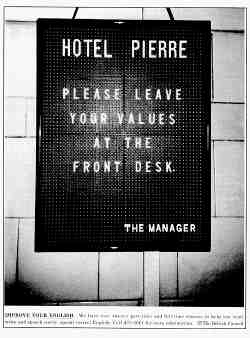
Some Interesting Newspaper Ads


Bail Bonds is such a unique industry

Cnet Rocks, but I like Slashdot better!

Nothing beats that value-added freebie

Saudi and Audi, what a combination!

Shock Advert has always paid off, until recently...

66 Items...One of my Favorites..

Yes, this also...

Values at Front desk, sounds like an hotel in Las Vegas Posted by Hello


Consumer Price Index, ah? Sure, with oil prices at 55$, Inflation is a problem even in the short term

Saturday, March 26, 2005

Yesterday, I came across a book called Happiness: Lessons from a New Science
by Richard Layard . The books is a multi-disinplinary book between psychology, sociology, applied economics, and other fields about what is defined as happiness and how increased western standards of living had no effect on happiness. I had the chance to read only the first few chapters of the book at the bookstore, however, it did captivate my attention of nearly half an hour. The book describes three main ideas that determine happiness in a person.

1. Status Race: We are more happy earning 100k a year when the average salary is say, 60k a year in the neighborhood than we are earning 150k a year compared to average salary of 180k a year. Most memorable quote i read related to this point.

A man is a very wealthy man if he earns 10 dollars more than his wife's sister's husband.

2. Security: Electrons try to be stable and loose energy/gain energy is achieve this state. In the same way, human beings want stability. They hate insecurity in jobs, in general life and are very unhappy about that. Maybe that is the reason why Japan was so successful during the middle of the cenutry, thanks to its no-firing policy at its companies. People tend to be more happier when they dont have to think about something they dont like.

3. Trust: You dont trust everybody and view each and everyone of them in suspision. This is also why you tend to be happiest among your friends and family, because you trust them. If you dont feel comfortable around them, then you got yourself a problem.

I have a weakness. A useless, harmless (?) weakness for horoscopes. I find them entertaining and ofcourse, do not pay for any service, thus it is harmless. Today, i decided to compile all the horoscopes i could find in one page for tommorow, i.e., saturday 26th 2005.

Let's start with Astrospeak, an Indiatimes website.

Daily Astrological Forecasts by Pt Kewal Anand Joshi

The period is emotion-charged and gives you greater freedom for self-expression. You have more than a fair share of satisfactory moments. Keep a watch over your health.
Tip of the day:You need to make daily exercise a part of your routine-even if you are very busy. Take extra care of your health now. At work, don't depend on anybody. Instead, innovate and work hard on y0our own steam to win success.

Daily Tarot Forecasts by Dr Deepak and Pinky Vaide

You now need to seek tangible, practical solutions. You will come up with something, so not a time for you to give up. Have faith in yourself.

Rediff.com

Your need to continue being persistent for that change within you, determined to get a new and more dynamic platform at your new work. Your temper is short and you are quick to judge, you choose to be peaceful than right! You recognise the difference, what difference does that make. Only positive, forge ahead!

Deccan.com

You see dreams being fulfilled. At home inability to control children leads to frustration. Your lover is likely to leave you confused. You sacrifice personal priorities for others.

Gulfnews.com

Life would be a lot easier if you could just make plans once and be done with it. But with so many changes going on, even simple arrangements benefit from being reorganised frequently. Instead of battling these, you’re better off exploring everything that arises.
The other day, Gulfnews ran a photo series on "A Day In the Life of UAE". I believe this photo showed the wide diversity in the city more than any other photo in the series.

A fisherman peacefully tends his livelihood as Jumeirah life buzzes on around him.

Dubai, more than the whole of UAE, is at the crossroads of development. UAE, a country with no more than a couple of tents, camels, and few human comforts, discovered oil at more or less the same time as its neighboring country, Saudi Arabia. However, the difference between the countries, apart from the size of the population, is the vision of its rulers. Although notperfect, they have successfully brought western investment as well as business tactics into an traditional Islamic culture.

Each country depends on four things for its development. Land, Labour, Capital and finally technology. In-house Technology is only possible if you have the two resources that are needed for it, i.e., Capital and Labour. Land does not play a huge role in technology revolutions of the present day. Land was available, and more importantly, so was capital, thanks to desert atmosphere and oil industry respectively. Both these resources were also available for Saudi Arabia. However the major difference is the way population played a role. Although both countries imported a large expatrite populations for their infrastructure projects, a development of middle class in the UAE has saved it from the problems of its neighbor. A strict control over population demograhics, UAE has successfully is in the process of trasforming its population from unskilled labour to a thriving middle and upper middle class populations of skilled/educated labour. Where Riyadh could not develop a economically successful middle class thanks to its regilious-institutional links, religious tolerance in Dubai, and in general the whole of UAE, has helped the country move towards more secular demograhic.

Modeled after the success of singapore in the east, Dubai managed to be the major trading and torist destination in the middle east. It is one of the few countries that can survive on non-oil revenues after the oil runs out. Now nationalities of nearly all nations of the world live in Dubai, making it in par with cities like London and New York in some ways. I say in some way, because, all said and done, the city-state is ruled by a absoulte monarc. There is a bill of human rights, and reinforeced quite often, but it is not democratic even in the lowest levels of governance. This however will not be premanant, and I believe democarcy in some form will be introducted to UAE citizens ( not everybody can become a citizen, even if you are born there) after this generation of rules. Most of the ruling community has been western educated in europe and united states, making a pr0-capitalist, western model of democarcy almost a sure thing. Almost, is because under this pro-capitalist and pro-western country live some of the same funders of Islamic Jihad against capitalistic western nations. An example of this can be found here.

Saturday, March 19, 2005

It has been quite a while since i blogged, and since i like to analyze why, the plain reason is that i did not find anything interesting to blog about. Maybe i did, however did not feel that i considered it important enough to write about it. Also you need to type it out which means work and alas, i am lazy. I did write some thing every long the other day for an email, so i have not lost the habit of writing.

Let me note down the points i need to wite about and then we can discuss each in detail, atleast as much as possible.

1. Charlie Rose: One of my favirote shows on the television, Charlie Rose is a talk show telecast at midnight in the local pubic television channel. Charlie interviews the prominant leaders/newsmakers/authors etc on his one hour show daily monday to friday. Apart from award winning jornalisic capabilities, his show features a dark room with single table and a couple of chairs for the participants. There are no people shooting the show since it is done remotely through the studio/recording room. This atmosphere allows a very intimate interview process, where charlie approachs his guest towards more personal/informative questions rather than interogating them. The website is http://www.charlierose.com

2. Morgan An Amercian Financier: Recently I brought two books, One called the Titan and the second one called Morgan An Amercian Financier. I started reading the second first and found it very informative biography.

For those of you who don't know, J. Peirpoint Morgan was one of the most prominant financier, or investment banker as one would call such a profession, along with his father Junius Morgan. Both father and son combo, the elder based in london and the younger in new york, successfully transferred much needed capital from european markets to the newly emerging industrial age of the states. It was the period between 1870's to 1920's that majority of the industrial ventures took place including railways, coal extraction, and oil. Called the gilded age due to the vast income differencials between the wealthy (who earned about 1 to 2 million dollars per year average) and the general working class ( whose wages topped off around 500$ per year), it would have been a very interesting place and time to be in the banking and money management sector.

However, few selected people sucessded in the profession and J. Peirpoint Morgan was one of them. Generally known companies of today such as General Electric and U.S. Steel were literally founded and nutured by him. Due to the anti-trust laws of the late 1920's ( which we still use against microsoft and other monoploies), the House of Morgan lost prominance into smaller companies such as Morgan Stanley and J.P.Morgan. ( I am not sure of J.P.Morgan but Morgan Stanley for sure)

In many aspects, the dot com boom and bust ( and infact the preceeding boom of the 1990's when capital from the rest of the world invested in markets of united states) is very much like the booms and busts during the railway construction period. Early in 2000, when i arrived in united states, and silicon valley, I heard an economic history professor comparing the railway boom to the bot com boom, among other booms and busts in recent history. I read further about the economic cycles of united states while taking of the classes at the university called "Economic History of United States" What I learnt in that one semester was only an overview, more like an introduction of sorts to economics cycles. What this book descibes in the most detailed method possible through the lives of the Morgan family and friends, as well as the businesses they were involved in, how life would have been during that time. The economic cycles, the personal drama, the money side of things, the greedness as well as the philanthropic side of the american elite. It is a story of how the american elite find a place in the books of history and how new york emerges at first as financial powerhouse comparable to old europe, and after the second world war, becomes the undisputed leader as financial capital of the world.

Tuesday, March 01, 2005

I knew "Blog" meant "Weblog", however, i did not know the difference between an online journal and a weblog. This Yahoo! Asks question cleared that for me!! Sometimes they do have some interesting research.

Friday, February 25, 2005

Lying in bed, I started to think of the differences between childhood and adult life in the modern world. Ofcourse, there are similarities between both phases of life, you are after all the same person. What I was wondering was about the experiences of higher stress in adult life than during childhood. There are many reasons that one can discuss at length but what I started thinking about is the effect of higher education on the thought process as an adult.

As an adult, you gather information about the whole around you. But as a child, you do the same. The differences is ofcourse in the nature of information, i.e., more inquisitive nature of a child learning perhaps languages and early human customs and traditions followed by adults surrounding him compared to gathering of information in a more structured manner as an adult. And considering that the amount of work a brain does is the same during both periods of the time, same 24 hours per day, I wonder what is the major difference between a child and an adult.

opinion seems to come first and foremost in my mind. I seem to have an opinion on everything from the Palestine-Israel war and Kashmir to how I want my hot tea to what is the best method to run a company. Opinion forming is encouraged in higher education, if you don't have an opinion, then you don't know knowledge in that matter and visa versa. You need to have a opinion on the discovery of United States by Columbus, why slave plantations worked in certain parts of the world where as they failed in others, why were salves liberated. I could go on and on about various issues the society expects an educated, well informed adult to have. The society at large determines your evaluation by the opinions you give. The more variety of subjects you have opinions about, the better. The more informed your opinions are, the better.

In the quest of finding more information, knowledge and thus more opinions, human beings routinely fall into categories that speak more about them as a society than as individuals. A typical scenario played out nowadays is if you are against war, you are against American soldiers in the war. Or even worst still, if you are against bush, you are against democracy in the united states. The race towards becoming more "opinionated" is leading to becoming more "stereotyped".

Stereotyping can have both negative aspects as well as positive ones. In the positive side, you expect say, "teachers and nurses to be honest and friendly" where as "lawyers and salesperson to be dishonest and untrustworthy". And we are repeatedly taught that more information would lead to less stereotyping. Tell that to an three year old. He or she might not even know the word stereotype, but would act in a manner that would put all the educated and opinionated world to shame.