Wednesday, January 31, 2007
Arab nominated for Holocaust honor
I am sure there is more people like him nowadays. It is just that we are not searching for them.

Monday, January 01, 2007
Monday, September 25, 2006
A Rose by any other name is still a Rose!
Or It should be "Rose from any country is still a Rose" . Gone are the days when Dutch farmers used to rule the flower market of the world, they are now facing increasing competition both in terms of logistics center as well as producers of flowers.
Dubai has plans to make itself a commerical center for flower trade, allocating land and resources for the same. The producer of the world, china is also taking a strong look into the flower power to sustain rural growth.
Dubai has plans to make itself a commerical center for flower trade, allocating land and resources for the same. The producer of the world, china is also taking a strong look into the flower power to sustain rural growth.
Saturday, September 16, 2006
Yahoo! Mail Beta
Yahoo has recently launched Yahoo! Beta, which features a Outlook-type interface. The interface is the second face-lift in the recent years, after Gmail gave tough compitetion to free email service. The advent of "free email" was started by hotmail, however, is now solely in the hands of yahoo and google.
You can find screenshots of the new Yahoo!Beta here. I was given a option to try the beta version, however, could not even login-in to the system. After all, it is still Beta!
You can find screenshots of the new Yahoo!Beta here. I was given a option to try the beta version, however, could not even login-in to the system. After all, it is still Beta!
Monday, August 21, 2006
Graphical Representation of this blog (and the net)


Saturday, August 19, 2006
Why is living in dubai so bad?
This is in reference to a post by Gautam. I have tried to think of reasons why people are more materialistic in this part of the world, especially in dubai. I can come up with the following reasons:
The other side of the coin is to look at it in terms of economics. The amount of disposable income proportional to your earnings was historically (not at present) high. The avenues for spending money or investments are limited since you cannot make the most important expenditure, i.e, your house. You got to spend money, thus, the high level of "Bling" in dubai.
How would you rectify it?
- Divided society among various nationalities and religions. Some of the best friends were Arabs when I stayed in united states, however, I am ashamed to say I know nobody here.
- Ever-bickering intra-communities. The kind of "keeping up with the Jones" among various communities is taken to an extreme here.
The other side of the coin is to look at it in terms of economics. The amount of disposable income proportional to your earnings was historically (not at present) high. The avenues for spending money or investments are limited since you cannot make the most important expenditure, i.e, your house. You got to spend money, thus, the high level of "Bling" in dubai.
How would you rectify it?
- Allow people to invest in this society. People care about their investments; society will improve itself.
- Encourage social connections between various people. The areas of dubai are divided into ethnic groups, with few or no exceptions. The idea of encouraging high-rise buildings in Abu Dhabi, I believe, was to control populations in case of a uprising due to any reason. This thought is out-dated and needs to be corrected. The recent problems in France is only but an indication of what is to come.
- Most importantly, improve educational institutions including universities. Students merge among other communities with little or no pre-conceived notions and good educational experiences will lead to better dubai-community.
Thursday, August 17, 2006
When is security too much to pay?
This is in relation to the diverting of a plane flying from london to washington d.c which was divered to boston for emergency landing. For those who do not know the story, you can find the same here.
I might be out on a limb here but what are the chances of an 60 year old women fusing about some cream - she was not allowed to take on the flight- a security risk? I mean, please I would take all the chances in the world in that sitution. I understand that the threat level is high and chances of a western target being attacked are quite high, but do 6o year old women who most lively lived here whole life in western countries want to detonate something? I would be suprised if she succeeded in hitting somebody with her walking stick.
Regardless of what the people think, terrorists are not crazy by birth. Rational thought and process is behind every action. It is, however, the assumptions that are to be blamed. In the movie "K-PAX", one of the scences shows a "crazy" man trys to hide under benches and avoiding sunlight. It is revealed that he believes sun rays will kill him, so he avoids them. His hiding behind benches is only the reaction.His thinking is not irrational, his assumptions are what is the problem to be resolved.
Similar is the case against the terrorists. They are not irrational human beings, they have come to believe in assumptions which you and i dont believe to be true. Any problem in this world can be solved if both sides can try to understand the assumptions and the reasons behind the assumptions that make up the conflict. Destroying cities, towers and subways will not change the assumptions. Open minded constructive critical thinking will.
Wednesday, August 09, 2006
Burj Dubai Facts and Figures
Listed below are facts and figures relating to Burj Dubai as per Emaar Magazine.
- Upon completion, the Burj Dubai will be the world's tallest building as well as the world's tallest man-made structure. (more here on present tallest man-made structure)
- The Burj Dubai spire will be visible from as far away as 95 kms.
- At 5,500 kg capacity, the firemen/service elevator will be the world's tallest service elevator.
- First mega-rise to have elevators with specially programmed, permit-controlled evacuation procedures. (I wonder how they work? Weren't we supposed Not to use evaluators in case of an emergency)
- Highest publicly accessible observation tower at 442 meters. ( Go up and watch miles and miles of desert as well as ocean I guess!)
- The curtain wall of Burj Dubai will be equivalent to 17 football fields.
- The total glass requirement is 142K sq/m
- Total concrete used is equivalent to 1900km sidewalk and weighs the equivalent to 100,000 elephants.
- There will be 200 meters of "dancing" fountains at the foot of Burj Dubai.
- Power requirement is 36 KVA is equivalent of 36K lights bulbs of 100 watts each operating at the same time.
- The cooling requirement is 10K tonnes of melting ice every day.
- 15 Million gallons of supplemental water are collected and drained every day
Friday, August 04, 2006
Dubai's Banking Sector in the world news!
With 47 Banking and many more financial institutes, the financial sector is highly competitive in UAE. Considering that they operate with little or no regulatory framework applied on their customers, UAE banking has developed its own flavor. Financial statements are re-organized for internal assessments of credit analysis. This is due to the fact that most companies do not show Positive Net Income, with all the Operating Income paid to the management/Directors as management fees. And this is only one example of financial manipulation that occurs here.
But this is set to change. Among the proposals in the pipeline is a Valued Added Tax and allowing businesses to have 100% ownership of companies outside the freezone areas. (compared to 51% - 49% ownership structure at present) All these regulations will help UAE to develop their financial sector.
Yahoo News has a related news article.
Friday, July 28, 2006
Lessons Dubai Can Learn
In a country where car-pooling is not encouraged, and atleast car-lifts are discouraged, washington DC shows the way in more ways than one.
Love This!



 If there is ever a reason why dubai would fail as a modern, forword-looking city along with the great visions of its leaders, it is due to the backward looking pressures from certain sections of the society.
That said, etisalat is providing servies in censorship that is needed to limit the shock effect on large section of the conservative society. Given a choice between having large section of the population surfing the net with censorship or having parents ban internet in their homes due to lack of blockage of inproper sites, i would prefer the earlier. I have noticed societies in the middle east *tend* to take extreme measures in most aspects. (Please feel to correct me if i am wrong!).
What is needed is a proxy-free internet for people who need it. Maybe something like the liqour license the govenment has. I know this is a money making idea, but money is what moves the organizations here. Atleast that would be a good start.
Now as for the reasons behind the proxy, that issue is a debate on its own merits.
Monday, July 03, 2006

Friday, June 30, 2006
Do Skyscrapers make sense?
Not always, so says the economist according to this article. Most skyscrapers, specially the really big ones, are ready long after the demand slows down for the office space. So does that mean dubai's economy will be slowing down considerably after 2009 ( By which time almost all planned skyscrapers will be built)?
Saturday, June 24, 2006
Yahoo! 360 Blocked
Finally, it happened! After blocking various blogging and networking sites, now Yahoo! 360, one of the newer products of Yahoo has been blocked by our own ISP. Is Blooger Next? ( Owned by Google)
UPDATE: Looks like Yahoo! 360 is back!.. I should have taken a screen shot :-)
UPDATE: Looks like Yahoo! 360 is back!.. I should have taken a screen shot :-)
Friday, June 23, 2006
Software Wars
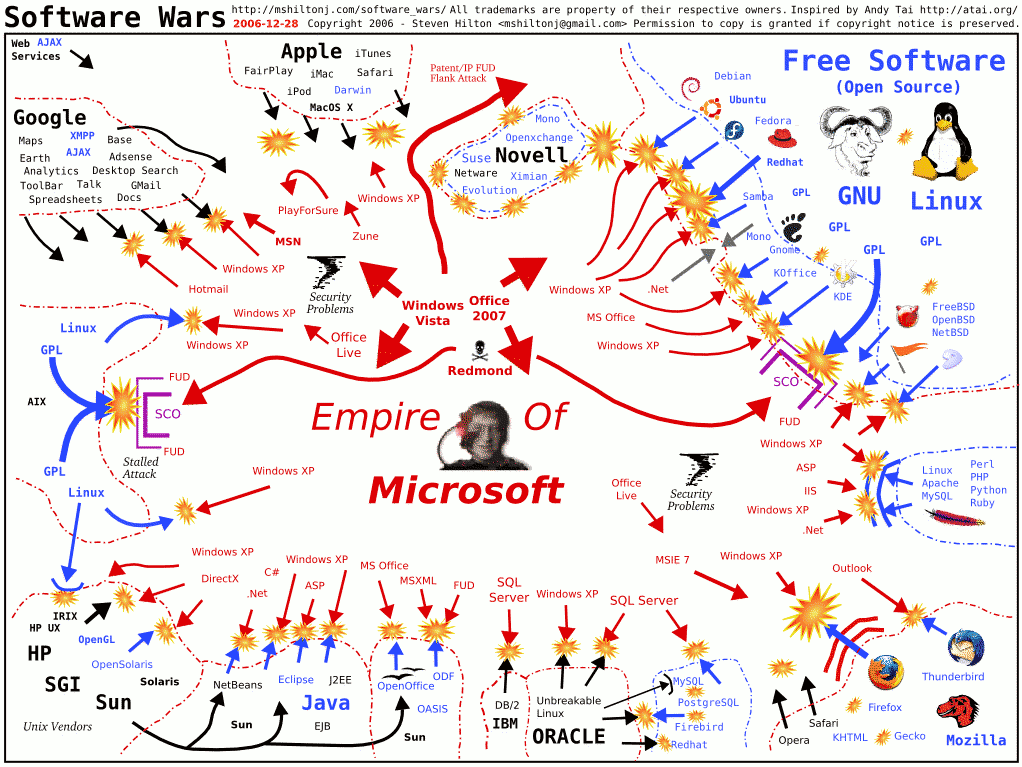
Microsoft and it's battles to maintain its world dominance is always a on-going struggle. As you can see the above graphic!
Sunday, June 04, 2006
UAE Year Book 2005
The New UAE Year Book for 2005 has been released. This document contains the latest govenment information including statistics and demographics of UAE. The book is published by govenment of dubai i believe.
Re-designed Trump Tower

 I recently came to know about the re-design of new Trump Building coming up as the center piece of plam jumairh. Although I believe no financial investment is being contributed by Mr. Trump, he would lend his name as well as his expertise in the new project. Notice the plam metro going through the new building.
Thursday, June 01, 2006
NY Times take on Air Arabia and Low cost airlines in the Gulf
Today, New York Times featured an article on "our own low cost airline" Air Arabia. Having a fleet of only 6 planes (owns five and leases one), air arabia flies from SHJ airport to nearby gulf cities, as well as the sub-continent. The airline is known for its cartoon ads showing "south-park" like characters.
Tuesday, May 30, 2006
Banks Closed Friday and Saturday (Most likely)
FYI. Most likely Banks will be closed on both Fridays and Saturdays from 1st of Sept. Presently banks work from Saturday to Thurday ( with most bank employees taking taking their weekend off either on thusday or Saturday, so that bank will continue to function as normal on Thursday). I will link the Central Bank circular, reported on gulf news, when I get a chance. Again this might be limited to National Banks only and private banks may or maybe follow the rule. Clarifications should be undertaken with your concerned bank.
I am posting this, since I saw some letters in 7 days regarding banking hours after the new working schedule comes into effect.
I am posting this, since I saw some letters in 7 days regarding banking hours after the new working schedule comes into effect.
Saturday, May 27, 2006
News Article on Coal from NYT ( Coal Theme: 2)
WRIGHT, Wyo. — More than a century ago a blustery Wyoming politician named Fenimore Chatterton boasted that his state alone had enough coal to "weld every tie that binds, drive every wheel, change the North Pole into a tropical region, or smelt all hell!"
His words seem prophetic.
The future for American energy users is playing out in coal-rich areas like northeastern Wyoming, where dump trucks and bulldozers swarm around 80-foot-thick seams at a Peabody Energy strip mine here, one of the largest in the world.
Coal, the nation's favorite fuel in much of the 19th century and early 20th century, could become so again in the 21st. The United States has enough to last at least two centuries at current use rates — reserves far greater than those of oil or natural gas. And for all the public interest in alternatives like wind and solar power, or ethanol from the heartland, coal will play a far bigger role.
But the conventional process for burning coal in power plants has one huge drawback: it is one of the largest manmade sources of the gases responsible for global warming.
Many scientists say that sharply reducing emissions of these gases could make more difference in slowing climate change than any other move worldwide. And they point out that American companies are best positioned to set an example for other nations in adopting a new technique that could limit the environmental impact of the more than 1,000 coal-fired power projects on drawing boards around the world.
It is on this issue, however, that executives of some of the most important companies in the coal business diverge. Their disagreement is crucial in the debate over how to satisfy Americans' growing energy appetite without accelerating climate change.
One of those executives, Michael G. Morris, runs American Electric Power, the nation's largest coal consumer and biggest producer of heat-trapping carbon dioxide emissions from its existing plants. He is spearheading a small movement within the energy industry to embrace the new technology. His company plans to build at least two 600-megawatt plants, in Ohio and West Virginia, at an estimated cost of as much as $1.3 billion each.
The company says these plants are not only better for the environment but also in the best interests of even its cost-conscious shareholders. While they would cost 15 to 20 percent more to build, Mr. Morris says they would be far less expensive to retrofit with the equipment needed to move carbon dioxide deep underground, instead of releasing it to the sky, if limits are placed on emissions of global warming gases.
"Leave the science alone for a minute," Mr. Morris said in an interview at the Columbus, Ohio, headquarters of his company. "The politics around climate issues are very real. That's why we need to move on this now."
But most in the industry are not making that bet. Among them is Gregory H. Boyce, chief executive of Peabody Energy, the largest private-sector coal producer in the world thanks in part to its growing operations here in Wyoming and with aspirations to operate coal-fired plants of its own. Mr. Boyce's company alone controls reserves with more energy potential than the oil and gas reserves of Exxon Mobil.
"We're still not convinced that the technology or cost structure is there to justify going down a path where we're not comfortable," Mr. Boyce said.
Mr. Boyce's view has prevailed. No more than a dozen of the 140 new coal-fired power plants planned in the United States expect to use the new approach.
The decisions being made right now in industry and government on how quickly to adopt any new but more costly technologies will be monumental.
"Coal isn't going away, so you have to think ahead," said Gavin A. Schmidt, a climate modeler at the Goddard Institute for Space Studies, part of NASA. "Many of these power stations are built to last 50 years."
Promise and Perils
Michael Morris and Gregory Boyce, both kingpins in their industries, have a lot in common. They do a lot of business together — Mr. Morris is one of Mr. Boyce's largest customers. They are solid Republicans. And they serve together on various industry initiatives.
They agree that energy from coal — the nation's most important source of electricity — is cheaper than energy from oil and natural gas and is competitive with the uranium used in nuclear power plants. And coal could serve new uses: replacing petroleum in making chemicals, for example, or even fueling vehicles.
But while sooty smokestacks are no longer a big problem in modern coal-burning power plants, the increase in global warming gases is. A typical 500-megawatt coal-fired electricity plant, supplying enough power to run roughly 500,000 homes, alone produces as much in emissions annually as about 750,000 cars, according to estimates from Royal Dutch Shell.
Coal has perhaps no stronger evangelist than Mr. Boyce, who grew up on Long Island, the son of a mining executive, and studied engineering in Arizona. He argues that a way to reduce carbon dioxide emissions can be found without having to switch from the existing cheaper coal-burning technology.
Much in the way that Exxon Mobil influences discussion of climate issues from the petroleum industry, Peabody is a backer of industry-supported organizations that seek to prevent mandatory reductions in global warming emissions and promote demand for coal.
Peabody's executives are also by far the coal industry's largest political contributors to federal candidates and parties, giving $641,059 in the 2004 election cycle, with 93 percent of that amount going to Republicans, according to the Center for Responsive Politics, an independent research group in Washington that tracks money in politics. And while Peabody says it expects contributions to Democrats to increase, under Mr. Boyce the company has cultivated close contact with the Bush administration.
Mr. Boyce was chairman of an advisory panel for the Energy Department, organized by the National Coal Council, that produced a controversial report in March calling for exemptions to the Clean Air Act to encourage greater consumption of coal through 2025. The thrust of the report, which Mr. Boyce outlined in an interview, is that improvements in technology to limit carbon dioxide emissions should be left to the market instead of government regulation.
By contrast, the environmental advocacy group Natural Resources Defense Council, which has brought many lawsuits aimed at controlling pollution, described the report as an "energy fantasy" that would increase carbon dioxide emissions by more than 2 billion tons a year.
But it is Peabody's economic argument, not the environmental opposition's, that is resonating throughout the electricity industry and among energy regulators.
Led by Peabody, dozens of energy companies have embarked on the most ambitious construction of coal-fired electricity plants since the 1950's.
Coal, as Mr. Boyce notes, is a bargain. Despite a doubling in domestic coal prices in the last two years, a surge in prices for natural gas, the preferred fuel for new power plants in the 1990's, has made coal more attractive.
With coal so favorably priced, Peabody saw an opportunity to enter the power-plant business itself, setting out to build two of the largest in the world, the 1,500-megawatt Prairie State Energy Campus in southern Illinois and the 1,500-megawatt Thoroughbred Energy Campus in western Kentucky. Both are in areas where the St. Louis-based company has substantial coal reserves.
Despite growing concern among some large energy companies over the liabilities they face if global warming advances or legal limits on carbon dioxide emissions become a reality, Peabody remains loyal to its technology choice. Vic Svec, Peabody's senior vice president for investor relations, said the possibility of near-term caps on carbon emissions was not viewed as a "material threat."
A Bet on Clean Technology
Mr. Morris, at American Electric Power, sees things differently. He cites cost concerns in arguing for its move to cleaner technology. At the request of environmental groups that hold shares in the company, A.E.P. agreed in 2004, shortly after Mr. Morris arrived, to report on the potential costs it would face if emissions rules were tightened. The company recognized that its growth beyond 2010 could be limited if it stuck with old technology.
The company has since won important allies in its push for cleaner coal, including General Electric, which is pinning much of its hopes for growth in the electricity industry on new technology and is working with A.E.P. on designing its plants.
One vital element of A.E.P.'s ambitions, and by extension those of other energy companies with similar projects, fell into place in April when the Public Utilities Commission of Ohio allowed the company to bill customers for a portion of the higher pre-construction costs for the plant it is planning in the state. The company hopes to complete construction of its first such plant by 2010.
Proponents of these plants, which turn coal into a gas that is burned to produce energy, say they would also emit much lower amounts of other pollutants that contribute to acid rain, smog and respiratory illness.
But for every small advance of the new technology, there are bigger setbacks. Many within the industry argue that it would be a waste of time and money to build such plants in the United States unless China, which passed the United States several years ago as the largest coal-consuming nation, also moves to limit carbon dioxide emissions from its rapidly growing array of coal-fired plants.
Will Government Act?
With widespread uncertainty in the state-regulated power industry, the debate has moved to the federal level, where testimony by senior energy executives before the Senate Energy Committee in April revealed a sharp fault line within the industry.
On one side, A.E.P., lined up with Peabody and other heavy coal users against mandatory limits on global warming gases if industrializing countries like China and India are not included. Others that have less to lose from carbon caps — like Exelon and Duke Energy, which rely much more on nuclear power — spoke in favor of national limits that would include coal consumers.
The Bush administration has rejected mandatory limits on carbon dioxide emissions. But there is some support in Washington for such legislation. The two senators from New Mexico, Jeff Bingaman, a Democrat, and Pete V. Domenici, a Republican, are working on a bill that could require limits on carbon dioxide emissions.
Ahead of the 2008 presidential election, two senators often mentioned as candidates, Hillary Rodham Clinton, Democrat of New York, and John McCain, Republican of Arizona, have endorsed mandatory cuts in emissions. Mr. Morris of A.E.P. said such support has persuaded him that limits might be imposed in coming years.
While Peabody supports some coal gasification projects, it remains skeptical about departing from traditional coal-burning methods to produce electricity.
The pulverized coal plants it wants to build, which grind coal into a dust before burning it to make electricity, currently cost about $2 billion each, or 15 percent to 20 percent less to build than the cleaner "integrated gasification combined cycle," or I.G.C.C., plants, which convert coal into a gas.
The hope among scientists is that I.G.C.C. plants could be relatively quickly fitted with systems to sequester deep underground the carbon dioxide created from making electricity. Without such controls, the new coal plants under development worldwide could pump as much carbon dioxide into the atmosphere over their lifetimes as all the coal burned in the last 250 years, according to Jeff Goodell, who has written on coal for several publications, including The New York Times, and is author of a new book on the coal industry.
But state and federal regulators have been hesitant to endorse the technology. Peabody and other companies remain skeptical that carbon-capture methods, whether for pulverized coal or combined cycle plants, will become commercially or technologically feasible until the next decade.
Legal battles over this reluctance have already begun, with the Natural Resources Defense Council and the American Lung Association this year challenging the Environmental Protection Agency for allowing electric companies to move ahead with power plant projects without evaluating the new technology.
In one key decision on the state level, the Wisconsin Public Service Commission rejected a proposal from WE Energies of Milwaukee in 2003 to build a plant with the new technology, saying it was too expensive and would result in higher electricity prices.
Capturing the Gas
Engineers have known how to make gas from coal for more than a century, using this method in the gaslights that first illuminated many American cities. A handful of coal gasification plants are already in operation in the United States, Spain and the Netherlands, built with generous government assistance.
Selling the captured carbon dioxide from coal gasification plants could make them more competitive with pulverized coal plants. One gasification plant in North Dakota, though different from an electric plant, already sends its carbon dioxide to Saskatchewan, where it is injected in aging oilfields to force more crude from the ground. And the oil giant BP announced a similar project in March for a refinery it owns near Los Angeles, using petroleum coke as a fuel there instead of coal.
Scientists have developed numerous other plans to pump away carbon dioxide, like shipping it to offshore platforms to inject it below the ocean floor. These plans are not without risk, with some officials concerned that carbon dioxide sequestration could trigger earthquakes. Yet, time and again, the most limiting factor remains economics.
As they proceed with plans to build pulverized coal plants, Peabody and other companies often point to their support of the alternative technology through their participation in Futuregen, a $1 billion project started three years ago by the Bush administration to build a showcase 275-megawatt power station that could sequester carbon dioxide and reduce other pollutants.
Futuregen's 10 members include some of the world's largest coal mining companies, among them Peabody and BHP Billiton of Australia, as well as large coal-burning utilities like A.E.P. and the Southern Company.
One Chinese company, the China Huaneng Group, is also a member of Futuregen, while India's government signed on in March. Washington is financing the bulk of the project, more than $600 million, with about $250 million coming from coal and electricity companies and the rest from foreign governments.
But Futuregen is already behind schedule, with planners now hoping to choose a site for the plant by the end of the year, with an eye on starting operation by 2012. Environmental groups have criticized the project as too little, too late.
"Futuregen is a smokescreen, since it's not intended to bring technology to the market at the pace required to deal with the problem," said Daniel Lashoff, science director at the climate center at the Natural Resources Defense Council. "We don't have that kind of time."
Subscribe to:
Posts (Atom)
